Weather in Redding CA
Questions and Answers
Q. Weather in Redding CA: Does it snow in Redding?
A. Snow, yes occasionally. Redding sits at the north end of the largest valley in California and gets the tail end of winter storms from the Gulf of Alaska which occasionally will produce a bit of snow. This happens on the valley floor once per year on average. Most of the time the snow melts off within a few hours, it could take 24 hours. Approximately every 5 years we'll get a few inches of snow in Redding from those storms described above. Occasionally a bowl effect that traps cold air in the valley is created by the surrounding mountains. On these occasions, we sometimes see the snow stay for a day or two.
Big Snow: (Redding style) Although very rare, every 20 or so years we get an accumulation of snow that has reached as much as a foot deep that falls by a series of a few storms.
Q. How hot does it get in Redding?
A. Let's look at this like a good politician would. The great thing about Redding is you know what season it is, with four distinct ones to enjoy. Our winters include rain that fills the surrounding lakes and keeps the forest green and healthy while still allowing days of sunshine to recharge our batteries.
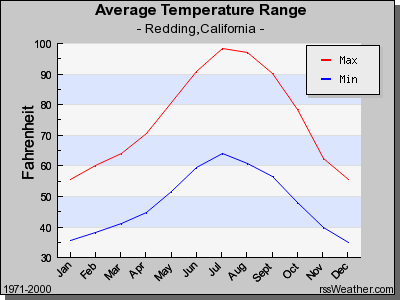
Weather in Redding CA in the Spring and Fall can't be beat! Awesome days and comfortable evenings by the bundles. A truly wonderful place to be whether it be on the valley floor on in the mountains. Ok, not so political now. For an average of 6 weeks in the middle of the summer it can be unpleasant in the afternoons. From mid July thru August it's best to do what you need done in the mornings and find shelter in the afternoons. Shasta Lake, Whiskeytown Lake, Mt Lassen, Mt Shasta, and local Waterfalls, are all popular spots through the spring, summer, and fall months. If you like the mountains, it's a great time to get out with a canoe or kayak while camping and enjoy the many small lakes in the area.
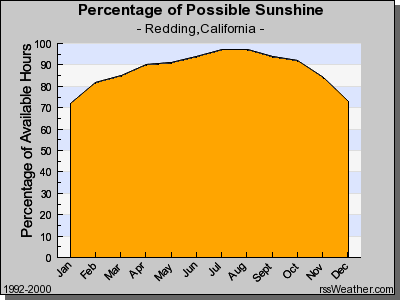
Q. The Redding city information says that Redding has 88% sunny days per year, which would be less than four days a month of not being sunny.....is that true?
A. Redding is a very sunny place, the statistic is basically true yet perhaps a bit misleading. Often, we have a day that gets a bit of rain or cloudiness that does not last all day, if the sun shows itself I think they count that as a sunny day.
Our weather patterns come primarily from the Gulf of Alaska and we often get the southern portion of storms. The storm tract results can be seen with Washington and Oregon getting significantly more rain and central and Southern California staying relatively dry. In this part of California, we are in between and you will experience all four seasons as a result.
In the winter we have snow covered mountains surrounding us: in the warm summer months those same mountains create a tourist magnet with outdoor activities and the nearby lakes are the icing on the top of the proverbial cake. During Spring and Fall you'll have a hard time finding a more beautiful place. In the winter months another factor to consider is fog. The central valley of California runs for about 450 miles from Redding in the north to the Bakersfield area in the south. The San Francisco Bay in the middle of this huge valley allows fog to enter and spread out, it can get very thick. With the weather pattern we have in Redding, most often it is blown south which again leaves us with those sunny days the question was originally about.
Q. How much rainfall does Redding get per year?
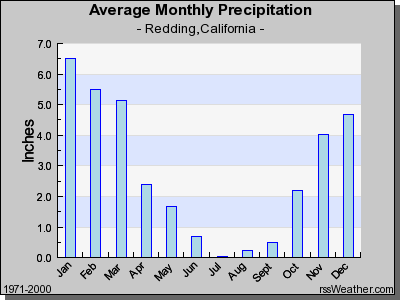
A. Weather in Redding CA, overall we get about 33 inches annually of rain as measured at Redding Municipal Airport. Due to Redding being at the far northern end of California's Central Valley and surrounded by mountains on three sides, different locations get different amounts depending on their proximity to those surrounding mountains. For instance, on the west side of town it will rain a bit more heavily than on the east where the Airport is located.
Another bit of information about our rainfall to keep in mind is how the rain totals are reached. Since I don't know where you are located, I'll paint with a broad brush. Looking well north of Redding into Oregon and Washington, during the winter months they have consistent overcast skies and all too frequently a mist or drizzle type of rainfall. Cities in those climates often get approximately the same rainfall totals as we do, but in a much different way. Our rainfall is generally more robust and comes down in larger quantities while it is raining. We get clear and nice wintertime sunny days with the temperatures in the 60's as well, that's when you can really enjoy the great views of the surrounding snow-covered mountains. The rainy season occurs primarily between November and early March, with January and February bringing the most rain, you can see this with the chart.